
A New York mechanic’s lien does not last forever. Filing the lien is only the first step. If the claim is not resolved, the lienor must calendar the expiration date and decide whether to extend the lien, commence a foreclosure action, or use another strategy before the lien remedy is lost.
For contractors, subcontractors, suppliers, owners, developers, and property stakeholders, lien-extension timing can become critical when a project remains unpaid but settlement discussions are still active. Waiting too long can turn a strong lien claim into an ordinary unsecured dispute.
How long does a New York mechanic’s lien last?
Under New York Lien Law Section 17, a private improvement lien generally does not continue for more than one year after the notice of lien is filed unless the lien is extended or a foreclosure action is timely commenced and the required notice of pendency is filed. That one-year date should be calendared immediately after filing.
The same basic one-year concept applies in the public improvement context, but the procedure is different because a public improvement lien is filed against funds rather than real property. Public improvement lien duration is addressed in Lien Law Section 18.
Why lien extension strategy matters
A mechanic’s lien often creates leverage because it affects title, project funds, closing, financing, payment applications, or project closeout. If the lien expires, that leverage may disappear even if the claimant still has a contract claim. The best time to decide whether to extend is well before the deadline, not in the final days before expiration.
The extension strategy should be tied to the status of the payment dispute. If negotiations are productive, an extension may preserve rights while the parties continue talking. If the owner or contractor refuses to pay, a mechanic’s lien foreclosure may be the better next step. If the lien has been bonded, the continuation rules and enforcement posture should be reviewed carefully.
How to extend a private commercial mechanic’s lien
For many private improvement liens that do not involve a single-family dwelling, the lien may be extended by filing an extension with the county clerk before the lien expires. The extension should identify the lienor, the owner, the affected property, the lien amount, and the date the original notice of lien was filed. The extension generally continues the lien for an additional year.
This may sound simple, but details matter. The extension should be filed in the correct county, tied to the correct lien docket information, and completed before the deadline. If the lien affects property in more than one county, or if there are questions about the owner, property description, or original lien filing, those issues should be reviewed before filing the extension.
How to extend a mechanic’s lien on a single-family dwelling
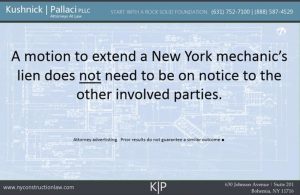
A lien on real property improved or to be improved with a single-family dwelling is treated differently. Under Lien Law Section 17, a single-family dwelling lien may be extended only by a court order. That means the lienor should leave enough time to prepare and file the application before the lien expires.
The timing of the application can be important. New York cases have addressed whether a motion to extend must be decided before the lien expires or whether timely filing of the motion is enough. Because the consequences of expiration can be severe, a claimant should not wait until the last possible day to seek court relief.
What if a foreclosure action has already started?
If a mechanic’s lien foreclosure action is commenced before the lien expires and the required notice of pendency is filed, a separate extension may not be necessary in the same way. The lien can be continued through the foreclosure action, subject to the requirements of the Lien Law and the rules governing the notice of pendency.
This distinction matters because filing a foreclosure action is not just another extension form. It starts litigation. Before commencing foreclosure, the claimant should evaluate the amount at stake, contract documents, defenses, necessary parties, lien priority, settlement posture, and whether the lien has been discharged by bond.
What if another lienor names you in a foreclosure action?
Multiple lienors may have claims against the same project. If one lienor commences a foreclosure action and properly names other lienors as parties, the named lienors’ liens may be continued under the statute when the required notice of pendency has been filed. This can be useful, but it should not be treated casually. A lienor should confirm that it was properly named, that the action was timely, and that the notice of pendency was properly filed.
In multi-lienor disputes, relying on someone else’s foreclosure action without confirming the details can be risky. The safer approach is to independently calendar your own lien deadline and verify whether your lien rights have actually been preserved.
How to extend a public improvement lien
A lien for labor or materials furnished for a public improvement is governed by a different continuation rule. Under Lien Law Section 18, a public improvement lien generally must be extended or foreclosed within one year from filing. The extension is filed with the comptroller or financial officer of the public corporation with whom the original notice of lien was filed, not with a county clerk in the same way as a private property lien.
Public improvement lien extensions should identify the lienor, the contractor or subcontractor for whom the work was performed or materials were furnished, the public improvement, the lien amount, and the original filing date. Because public improvement liens attach to funds and not the public property itself, the filing location and enforcement strategy must be handled carefully.
Extension options at a glance
| Type of lien | Basic continuation method | Practical caution |
|---|---|---|
| Private commercial improvement | Often extendable by filing an extension with the county clerk before expiration. | Confirm property, owner, original filing date, docket information, and county requirements. |
| Single-family dwelling | Requires a court order to extend. | Do not wait until the deadline; prepare the application early. |
| Public improvement | Extension or foreclosure must follow the public improvement procedure. | Filing is tied to the public officer or entity with whom the lien was filed. |
| Foreclosure already commenced | A timely foreclosure action and notice of pendency may continue the lien. | Confirm the action, notice of pendency, parties, and timing. |
| Bonded or discharged lien | Continuation rules can still matter, but the claim may proceed against the bond or deposit. | Review the bond, order, parties, and enforcement deadline. |
Checklist before extending a mechanic’s lien
- Confirm the exact filing date of the original notice of lien.
- Calculate the expiration date and leave time for filing or court action.
- Identify whether the project is private, single-family residential, or public improvement.
- Confirm the correct owner, property, lien amount, and original lien docket information.
- Decide whether extension, foreclosure, settlement, or a lien release is the better strategy.
- Check whether the lien has been bonded, discharged, partially satisfied, or challenged.
- Confirm whether any pending foreclosure action by another lienor actually preserves your lien.
- Preserve the documents needed to prove the claim if the matter becomes litigation.
Common mistakes with lien extensions
The most common mistake is waiting too long. Other common problems include using the wrong continuation procedure, treating a single-family dwelling lien like a commercial lien, filing in the wrong place, failing to start foreclosure when extension is no longer enough, or assuming settlement discussions stop the lien clock. They do not.
Another mistake is focusing only on the extension form while ignoring the claim itself. If payment remains disputed after extension, the claimant may eventually need to prove entitlement to the amount claimed. That means the lienor should organize invoices, change orders, contracts, payment applications, daily reports, delivery tickets, correspondence, credits, backcharges, and proof of last work.
Related mechanic’s lien resources
- New York mechanic’s lien basics
- How to file a mechanic’s lien in New York
- Mechanic’s lien foreclosure
- Mechanic’s lien discharge bonds
- Public improvement liens in New York
- Motion to extend a New York mechanic’s lien
Frequently asked questions
How long does a New York mechanic’s lien last?
A private mechanic’s lien generally lasts one year from filing unless it is extended or a foreclosure action is timely commenced with the required notice of pendency.
Can every mechanic’s lien be extended by filing a simple extension?
No. Many private commercial liens can be extended by filing, but liens involving single-family dwellings require a court order. Public improvement liens have their own continuation procedure.
Does a lien extension guarantee payment?
No. An extension preserves the lien remedy for additional time. It does not prove the claim or force payment by itself.
Do settlement discussions extend the lien deadline?
No. Settlement discussions do not stop the lien clock unless the parties take legally effective action to preserve or resolve the lien.
What happens if the lien expires?
If the lien expires without proper extension or foreclosure, the lien remedy may be lost even if the claimant still has a separate contract claim.
Need to preserve a mechanic’s lien?
Speak with Kushnick Pallaci about your next step.
Our New York construction attorneys help contractors, subcontractors, suppliers, owners, developers, and property stakeholders evaluate lien deadlines, extensions, foreclosure strategy, lien challenges, bonds, releases, and payment disputes.
