
What is a Home Improvement Contractor License?
Many jurisdictions in New York require those that perform Home Improvement work to hold a Home Improvement Contractor License. This is especially true in New York City and Long Island. In fact, each jurisdiction may have a different definition of exactly what constitutes “home improvement” work. There is a statewide definition found in G.B.L. Section 770 that, while not binding on each jurisdiction, is quite similar to the definition in each jurisdiction. Under G.B.L. Section 770, Home Improvement means:
the repairing, remodeling, altering, converting, or modernizing of, or adding to, residential property and shall include, but not be limited to, the construction, erection, replacement, or improvement of driveways, swimming pools, siding, insulation, roofing, windows, terraces, patios, landscaping, fences, porches, garages, solar energy systems, flooring, basements, and other improvements of the residential property and all structures or land adjacent to it. “Home improvement” shall also mean the construction of a custom home, the installation of home improvement goods or the furnishing of home improvement services.
If you are performing work that falls under the definition then you must hold a license. In fact, if you do not have a license you are likely committing a crime and are waiving any right to payment!
If I Have a Suffolk County Home Improvement Contractor License is that Enough?
Well, maybe. It depends on where you are performing the work. If you are performing home improvement work within Suffolk County then your license allows you to perform that work anywhere within the County unless the local municipality has its own licensing requirements.
What Municipalities in Suffolk County Have Their Own Home Improvement Licensing Requirements?
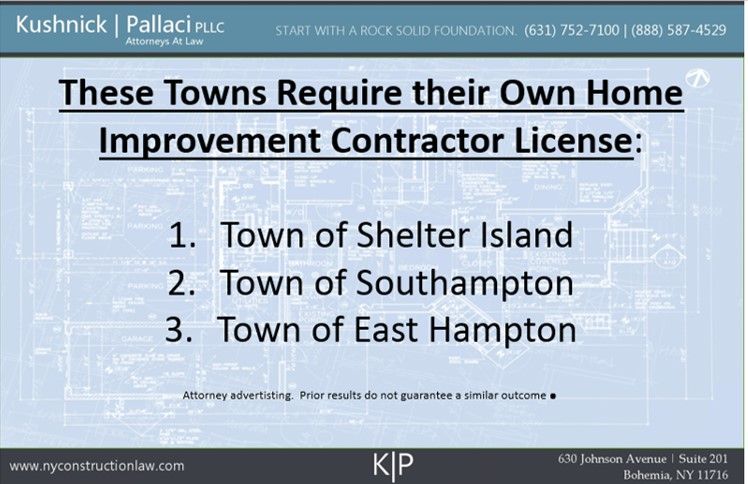
The following jurisdictions within Suffolk County will require you to get a separate home improvement contractor license. Your Suffolk County license will not be enough to allow you to perform work (and be paid for it):
- The Town of Southampton
- The Town of Shelter Island
- The Town of East Hampton
What is the Definition of Home Improvement Work in those Jurisdictions that Require Their Own License?
Suffolk County defines Home Improvement Contracting work as:
Excluding work in the electrical and plumbing fields as defined by § 563-126 of this chapter, any repair, remodeling, alteration, conversion, modernization, home raising or home elevating services, improvement or addition to residential property, and includes but is not limited to painting of residential structures; carpentry; fencing; driveways; exterminating; flooring; ductwork for heating, ventilation and air-conditioning systems; masonry; roofing; siding; the construction, installation and/or servicing of swimming pools and portable and permanent spas; and waterproofing; as well as other improvements to structures or upon land which are part of residential property, including landscaping and arboriculture, which as used herein shall mean tree sprayers, tree pruners, tree stump removers and all other tree services; but shall not include the construction of a new home or work done by a contractor in compliance with a guaranty of completion on new residential property or the sale of goods by a seller who neither arranges to perform nor performs, directly or indirectly, any work or labor in connection with the installation of or application of the goods or improvements to residences owned by or controlled by any government subdivision.
The Town of East Hampton defines Home Improvement as:
New home construction, and/or any repair, remodeling, alteration, conversion, modernization, improvement or addition to existing residential premises and/or improvements, regardless of the zoning district in which such property may be situated, and shall include but not be limited to any such activity with regard to additions, alarm systems, awnings, basements, bathrooms, bulkheads, cabinets, carpentry, central air conditioners or vacuum cleaners, cesspools, decks, docks, dormers, driveways, electrical systems, extensions, extermination, fencing, flagpoles, flooring, fumigation, garages, gutters, heating, jetties, kitchens, landscaping, landscape contracting, masonry, interior or exterior painting, plumbing, railings, renovations or remodeling, roofing, septic tanks, siding, solar/wind energy systems, sprinklers, storm windows and screens, swimming pools, tennis courts, termite control, tile, waterproofing, weatherproofing and ventilation
The Town of Shelter Island defines Home Improvement as:
Any construction, repair, remodeling, alteration, conversion, modernization, improvement or addition to residential or commercial property, and shall include but not be limited to air conditioning, alarm systems, awnings, basements, bathrooms, bulkheads, cabinetry, carpentry, central vacuum cleaning systems, cesspools, construction management, dock, dormers, driveways, extensions, exterminating, fencing, flagpoles, flooring, fumigation, garages, heating, kitchens, masonry, railings, roofing, septic tanks, siding, sprinklers, storm windows and screens, swimming pools, tennis courts, termite control, tile installation, ventilation, waterproofing and weatherproofing
The Town of Southampton defines Home Improvement as:
The repairing, remodeling, altering, converting or modernizing of, or adding to, residential property and shall include, but not be limited to, the construction, erection, replacement or improvement of central air conditioning, awnings, bathrooms, cabinets, carpentry, central vacuum cleaners, chimneys, decks, dormers, drainage systems, extensions, flagpoles, fumigation, heating, kitchens, masonry, painting, railings, renovations, sprinklers, storms and screens, tennis courts, tile installers, ventilating, water weatherproofing, driveways, swimming pools, siding, insulation, roofing, windows, terraces, patios, landscaping, fences, porches, garages, solar energy systems, flooring, basements, erosion protection structures and improvements, such as a jetty, groin, revetment, breakwater, bulkhead, geotube, sandbag installation or other artificial beach nourishment project which requires a permit pursuant to Chapter 111 or 138 of the Town Code, improvements made pursuant to Chapter 123 or 169 of the Town Code to bring residential property into conformance with applicable flood prevention regulations, including, but not limited to, placement of structures on pilings or relocation of structures, and other improvements of residential property and all structures or land adjacent to it. “Home improvement” shall also mean the installation of home improvement goods or the furnishing of home improvement services.
Because performing work without a valid license absolutely voids any right to payment, it is crucial that you obtain a license and know what jurisdiction you are working in. If you end up in litigation you could very well not be able to collect payment for otherwise properly performed work. Contact one of our construction attorneys now to discuss your home improvement contractor license issue including disputing violations.