
If you are in the construction industry in New York, chances are that at some point you have either asked for a “lien release” or “lien waiver” or been asked to sign one. But do you take the time to read the document and confirm what rights are being released? If not, you should. All lien releases and lien waivers are not created equally.
A lien waiver or lien release usually appears at the point where payment leverage is highest: progress payments, retainage, final payment, project closeout, refinancing, sale of the property, or settlement of a filed mechanic’s lien. Whether you are an owner paying a general contractor, a general contractor paying a subcontractor, or a contractor paying a supplier, the document should match the payment being made and the rights that are actually intended to be released.
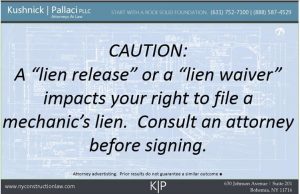
The practical problem is that construction payment forms often use the words “release,” “waiver,” “satisfaction,” and “discharge” loosely. A short form can affect mechanic’s lien rights, contract claims, change orders, retainage, delay damages, bond claims, and settlement leverage. The title of the document is useful, but the operative release language is what matters.
Lien release vs. lien waiver: the core distinction
In New York construction practice, a lien waiver usually concerns lien rights before a mechanic’s lien has been filed. It is commonly exchanged with a progress payment or final payment to confirm that the contractor, subcontractor, supplier, or laborer is waiving the right to file a mechanic’s lien for the paid work, paid amount, or defined payment period.
A lien release, lien satisfaction, or lien discharge usually concerns a mechanic’s lien that has already been filed. Once a notice of lien is on record, the parties may need a certificate of release, partial satisfaction, discharge bond, court order, settlement agreement, or other document that removes or limits the lien from the public record. That is a different legal problem than simply exchanging a waiver for a payment application.
New York Lien Law Section 34 and advance waivers
New York Lien Law Section 34 is the starting point for waiver analysis. It generally makes an agreement waiving the right to file or enforce a mechanic’s lien void as against public policy. In plain English, a contractor or subcontractor generally should not be forced at the beginning of a project to give up statutory lien rights before work is performed or materials are supplied.
The same statute also recognizes an important commercial reality: lien waivers are allowed when executed and delivered simultaneously with or after payment for labor performed or materials furnished. That is why the timing, payment amount, payment period, and effective language of the waiver matter. A waiver given with payment is very different from a broad advance waiver buried in a construction contract before the work begins.
New York Lien Law Section 19 and filed lien releases
If a mechanic’s lien has already been filed, the analysis shifts. New York Lien Law Section 19 addresses several ways a lien for a private improvement may be discharged, including a certificate from the lienor stating that the lien is satisfied or released, failure to timely foreclose or continue the lien, court order, filing a discharge bond or undertaking, and certain facial defects in the lien.
For that reason, a contractor who has filed a lien should be careful not to sign a broad “release” without confirming whether it releases only the lien, only part of the property, only a settlement amount, or all project claims. Owners and general contractors should be equally careful. A document that is too narrow may not remove the title problem; a document that is too broad may create unnecessary disputes about what was settled.
Common documents and what they usually mean
| Document | Typical use | What to watch |
|---|---|---|
| Partial lien waiver | Progress payment or a defined payment application. | The waiver should be limited to the paid amount, payment period, and work covered by that progress payment. |
| Final lien waiver | Final payment or project closeout. | Retainage, change orders, delay claims, back charges, and disputed extras should be resolved or reserved. |
| Conditional lien waiver | Payment has been promised but has not cleared. | The condition should clearly say that rights are released only to the extent payment is actually received. |
| Unconditional lien waiver | Payment has cleared and the release is intended to be effective immediately. | Do not sign as a matter of routine if funds have not actually been received. |
| Lien release or satisfaction | A filed mechanic’s lien is being removed, reduced, satisfied, or settled. | The release should match the lien, property, settlement, bond, and claims being resolved. |
| Lien discharge bond | An owner or contractor substitutes a bond for the property to discharge the lien from the real estate. | The lien may move from the property to the bond; the payment dispute may still continue. |
Partial waivers should match the progress payment
A partial lien waiver should usually identify the project, property, parties, payment application, through-date, and payment amount. It should not accidentally operate as a final waiver. If a subcontractor is receiving payment for requisition number five, the waiver should not release unpaid work through requisition six, retainage, pending change orders, or disputed extra work unless that is the negotiated deal.
Owners and general contractors benefit from clear partial waivers because they reduce double-payment and lien exposure. Contractors and subcontractors benefit because a properly limited waiver confirms payment without surrendering unrelated rights. The best forms are precise rather than aggressive.
Final waivers require closeout discipline
A final lien waiver is more serious because it often closes out a party’s lien rights for the entire project. Before signing one, confirm whether the payment is actually final. If retainage remains open, a change order is still pending, a back charge is disputed, a delay claim has not been resolved, or a payment bond or lien discharge issue remains in play, the waiver should be revised or the unresolved items should be expressly carved out.
Our separate New York final lien waiver form guide explains final waiver issues in more detail. The key point is simple: a final waiver should not be used as a progress-payment shortcut.
Conditional vs. unconditional lien waivers
An unconditional lien waiver can be appropriate when payment has already cleared and the signer intentionally releases lien rights for the covered work. It can be risky when the waiver says payment has been received but the money is only expected, pending, or subject to lender funding.
A conditional lien waiver is often safer when payment and paperwork are being exchanged at the same time. It can state that the waiver becomes effective only to the extent payment is actually received and clears. Owners, lenders, and general contractors may prefer unconditional waivers, but that commercial preference does not eliminate the need to align the document with the payment mechanics.
Checklist before signing a lien waiver or release
- Confirm the correct project, owner, property, contractor, subcontractor, supplier, and payment application.
- Verify whether the document is partial, final, conditional, or unconditional.
- Compare the waiver amount to the payment actually being made.
- Check the through-date and the work covered by the waiver.
- Reserve unpaid retainage, pending change orders, disputed extra work, delay claims, and unresolved back charges.
- Confirm whether the form releases only mechanic’s lien rights or all claims.
- Determine whether a filed lien requires a separate release, satisfaction, discharge bond, or court filing.
- Review lien filing and service deadlines under New York Lien Law Section 10 and Lien Law Section 11 if payment is uncertain.
Common mistakes that create disputes
The most common lien waiver problem is signing a document that is broader than the payment. That can happen when a final waiver is used for a progress payment, when an unconditional waiver is signed before funds clear, or when a form releases “all claims” rather than only mechanic’s lien rights for a defined amount.
Another common mistake is failing to distinguish a waiver from a release of a filed lien. If a lien has already been filed, title companies, owners, lenders, and closing counsel may need a specific lien satisfaction or discharge document. A generic waiver may not be enough to clear the record, and a generic release may give up more than the lienor intended.
When legal review is worth it
Legal review is especially worthwhile when the payment is substantial, the waiver is final, a mechanic’s lien has already been filed, retainage or change orders remain unpaid, the project is in dispute, or the form includes broad release language. A short review before signing can preserve lien rights, avoid an accidental claim release, and make project closeout cleaner for every side of the transaction.
Kushnick Pallaci PLLC reviews and prepares lien waivers, lien releases, mechanic’s lien documents, lien discharge papers, construction payment agreements, and project closeout documents for New York owners, contractors, subcontractors, suppliers, developers, and design professionals. Contact the firm before signing a lien waiver or releasing a filed mechanic’s lien.
Frequently asked questions about lien releases and lien waivers
Is a lien waiver the same thing as a lien release in New York?
Not always. A lien waiver is usually exchanged with a payment before a lien is filed, while a lien release or satisfaction usually removes or resolves a mechanic’s lien that has already been filed. The wording controls, so the title of the form is not enough.
Can a New York contractor waive lien rights before work starts?
New York Lien Law Section 34 generally makes advance waivers of mechanic’s lien rights void as against public policy. The statute does allow a written waiver executed and delivered simultaneously with or after payment for labor or materials.
Should a lien waiver be conditional or unconditional?
If payment has not cleared, a conditional waiver is usually safer because it ties the release to actual receipt of payment. An unconditional waiver can be appropriate after payment is received, but it should still be limited to the correct project, period, amount, and claims.
What claims should be carved out of a lien waiver?
Common carve-outs include unpaid retainage, pending change orders, disputed extra work, delay claims, back charges, payment bond claims, trust fund claims, and work performed after the payment period covered by the waiver.
What happens if a mechanic’s lien has already been filed?
Once a mechanic’s lien has been filed, the parties usually need a lien release, satisfaction, discharge bond, court order, or other discharge procedure. New York Lien Law Section 19 addresses several ways private improvement liens may be discharged.
Need help with a lien waiver or lien release?
Speak with Kushnick Pallaci before signing away project rights.
Our New York construction attorneys review lien waivers, lien releases, mechanic’s liens, discharge bonds, payment documents, retainage disputes, and construction contract claims for owners, contractors, subcontractors, suppliers, and developers.
Lien release and lien waiver decision matrix
The document title is not enough. The practical question is whether the document is intended to waive future lien rights, confirm payment for a progress draw, release a filed notice of lien, settle disputed claims, or close out the project entirely. That distinction matters because New York treats advance lien waivers differently from waivers exchanged with or after payment and differently from releases of liens already filed.
| Document | Best use | Risk to control |
|---|---|---|
| Progress lien waiver | Payment applications and periodic draws. | Do not waive unpaid retainage, pending extras, or claims outside the draw period. |
| Final lien waiver | Final payment and project closeout. | Confirm the money has cleared and preserve disputed claims if they are not being settled. |
| Lien release or satisfaction | Discharging a notice of lien that has already been filed. | Make sure the county record, bond, escrow, or settlement terms match the release. |
| Settlement release | Resolving broader construction disputes. | Draft carve-outs for warranty, indemnity, insurance, trust fund, bond, and lien foreclosure issues where needed. |
Related waiver, release, and mechanic’s lien resources
- Mechanic’s lien attorneys
- New York mechanic’s lien deadlines
- How to file a mechanic’s lien in New York
- Free New York mechanic’s lien form
- Cost to file a mechanic’s lien
- Mechanic’s lien pros and cons
- Final lien waiver form
- Lien release vs. lien waiver
- Mechanic’s lien foreclosure
- Lien Law Section 38 itemization demands
- Public improvement liens

